

Healthcare practice management involves the coordination of administrative,
financial, and operational activities that support the delivery of clinical services.
Patient registration, appointment scheduling, insurance verification, billing,
credentialing, documentation, and communication must be handled through
defined processes to maintain accurate information and consistent workflows.
As practices manage increasing patient volumes and administrative requirements,
disconnected processes can create delays, duplicate work, and additional demands
on internal staff. A structured approach to practice management helps
organizations assign responsibilities, monitor routine activities, and maintain
coordination between front-office and back-office functions.
Medical Practice Management Solutions New York provide support for these
non-clinical functions according to the requirements of individual healthcare
organizations. FCHMSO supports medical and physical therapy practices across
the United States with administrative, billing, credentialing, and revenue cycle
services.
Core Functions of Practice Management Support
Practice management support covers a range of non-clinical activities required for
day-to-day healthcare administration. The specific functions may differ according
to specialty, staffing structure, patient volume, and organizational requirements.
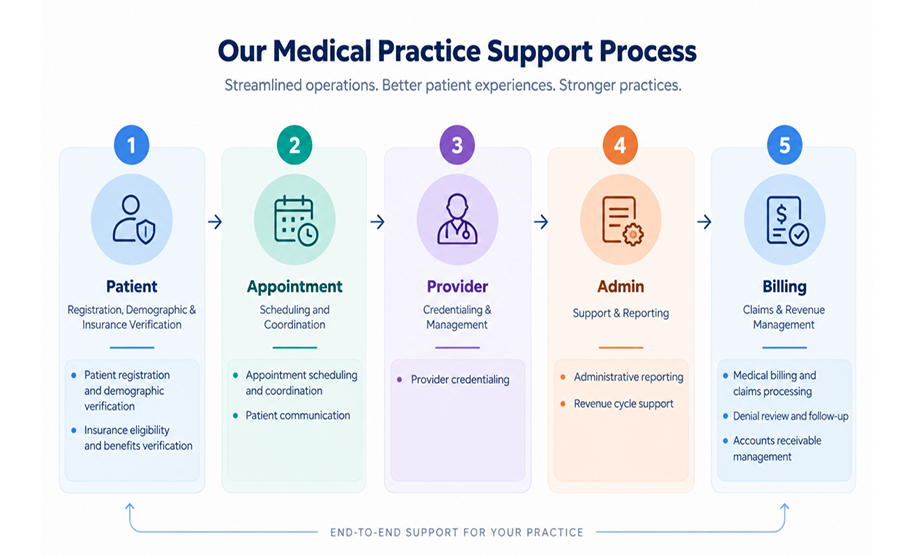
Each function produces information that may be required by subsequent processes.
For example, accurate demographic and insurance information supports eligibility
verification and claim preparation, while properly documented billing activity
supports payment reconciliation and accounts receivable monitoring.
Importance of Coordinated Practice Workflows
Healthcare administration involves multiple connected processes rather than
isolated tasks. Inaccurate patient information can affect eligibility verification,
authorization, billing, and claims. Similarly, incomplete documentation can delay
claim submission or require additional follow-up.
Defined workflows establish the sequence of activities, clarify responsibilities, and
provide a consistent method for handling routine transactions. Monitoring these
processes can also help practices identify incomplete tasks and address
administrative issues before they affect subsequent stages.
Medical Billing Within Practice Management
Medical billing is closely connected to front-end administrative processes. Claim
preparation depends on information collected during registration, insurance
verification, authorization, documentation, coding, and charge entry.
A Medical Billing Company NY can support functions such as claim submission,
payment posting, denial follow-up, and accounts receivable management.
Coordinating these activities with front-office processes helps maintain continuity
between patient information, claims, payments, and outstanding balances.
Accurate billing records also provide practices with information for reviewing
claim activity, payment status, and unresolved accounts within the revenue cycle.
Healthcare Management Services for Administrative Coordination
Healthcare organizations may use external administrative support when specific
functions require additional personnel or specialized experience. HealthcareManagement Services in Yonkers can cover areas such as patient access,
scheduling, insurance verification, credentialing, billing, and related administrative
activities.
The scope of outsourced services can be selected according to the practice’s
requirements. This allows organizations to assign defined administrative functions
externally while maintaining their existing internal structure and clinical
responsibilities.
Operational Benefits of Structured Practice Management
Consistent Administrative Processes
Defined procedures provide staff with established methods for handling
registration, scheduling, verification, billing, and follow-up activities.
Better Information Coordination
Accurate information exchange between administrative and financial functions can
reduce inconsistencies and support downstream processes.
Organized Revenue Cycle Activities
Connecting claims, payments, denials, and accounts receivable activities provides a
structured approach to monitoring financial transactions.
Flexible Administrative Support
External support can be adjusted according to patient volume, staffing
requirements, specialty-specific needs, and changes in practice operations.
Evaluating a Practice Management Provider
Healthcare organizations should evaluate a practice management provider based on
relevant industry experience, service coverage, communication procedures,
reporting capabilities, technology, and familiarity with healthcare administrative
requirements.
Clear responsibilities should be established for information exchange, task
ownership, documentation, billing activities, reporting, and follow-up. A defined
service structure helps the practice and external provider coordinate activities
without creating uncertainty about operational responsibilities.
Enhancing Administrative Coordination
Medical Practice Management Solutions coordinate administrative, financial,
patient access, billing, credentialing, and revenue cycle functions within healthcare
practices. Defined workflows and accurate information exchange support
consistent handling of interconnected non-clinical activities. FCHMSO provides
healthcare administrative and revenue cycle support across the United States for
medical and physical therapy practices.