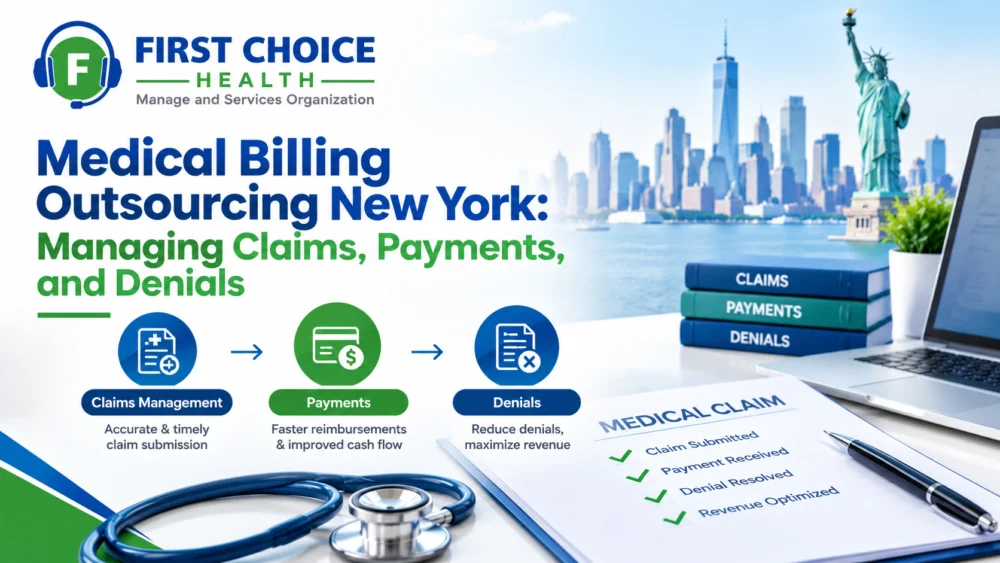
Medical billing involves several administrative and financial functions that must be completed accurately and within established workflows
Medical billing involves several administrative and financial functions that must be completed accurately and within established workflows. Patient registration, insurance verification, coding, charge entry, claim submission, payment posting, denial follow-up, and accounts receivable management are connected stages of the revenue cycle. Errors or delays in one stage can affect subsequent billing activities and reimbursement processing.
As healthcare practices expand, the volume and complexity of billing work can increase. Payer-specific requirements, incomplete documentation, claim rejections, unresolved balances, and ongoing follow-up can require significant administrative resources. Managing these functions internally may also require dedicated personnel, training, technology, and process oversight.
Medical Billing Outsourcing New York allows healthcare organizations to assign selected billing functions to an external service provider. The scope can range from specific revenue cycle tasks to comprehensive billing support, depending on the practice’s operational requirements. FCHMSO provides billing and administrative support to healthcare organizations across the United States.
Key Functions Included in Medical Billing Outsourcing
Outsourced billing support can cover different stages of the revenue cycle.
Common functions include:
● Patient demographic and insurance information verification ● Insurance eligibility and benefits verification ● Charge entry and coding coordination ● Healthcare claim preparation and submission ● Claim status monitoring ● Payment posting and reconciliation ● Denial review and follow-up ● Accounts receivable management ● Patient billing assistance ● Revenue cycle reporting The specific combination of services depends on the practice’s specialty, payer mix, patient volume, existing staff, and internal billing procedures. Defined responsibilities between the healthcare organization and external billing team help maintain continuity throughout the process.
Operational Considerations for Outsourced Billing
Medical billing requires accurate information at multiple points in the revenue cycle. Patient demographics, insurance details, authorization information, clinical documentation, and coding data can affect claim processing. Outsourced billing teams can review available information, process claims according to established procedures, and identify transactions requiring additional attention.
Claim monitoring is another important function. Rejected or denied claims may require correction, additional documentation, payer communication, or other follow-up. Systematic tracking helps distinguish unresolved claims from completed transactions and supports organized accounts receivable management.
Administrative Benefits of External Billing Support
Outsourcing selected billing functions can change how internal resources are allocated. Rather than maintaining every billing activity within the practice, organizations can assign defined processes to an external team with relevant billing experience.
This model may reduce the amount of routine billing work handled directly by clinical or administrative staff. It can also provide access to personnel familiar with claim processing, payment posting, denial follow-up, and revenue cycle reporting without requiring the practice to establish a larger internal billing department.
The operational effect depends on the services outsourced, existing workflows, payer requirements, and the level of coordination between the practice and service provider.
Healthcare Outsourcing for Broader Administrative Functions
Outsourcing can extend beyond medical billing. Healthcare organizations may require assistance with patient access, appointment scheduling, insurance verification, credentialing, administrative coordination, and other non-clinical functions.
Healthcare Outsourcing Services NY can provide additional administrative capacity based on the practice’s workload and operational structure. Separating specific administrative functions from clinical responsibilities can help establish clearer task ownership and workflow coordination.
Physical Therapy Billing Requirements
Physical therapy practices may encounter billing requirements associated with treatment documentation, coding, authorization, visit limits, payer policies, and claim processing. These requirements can vary according to the patient’s insurance plan and applicable billing procedures.
Physical Therapy Billing Services Yonkers can support functions such as claim preparation, submission, payment posting, denial follow-up, and accounts receivable activities. The appropriate level of support depends on the clinic’s existing billing structure and the functions it chooses to outsource.
Selecting a Medical Billing Outsourcing Partner
Before engaging an external billing provider, healthcare organizations should evaluate experience with relevant specialties and payer requirements, service coverage, reporting procedures, communication practices, technology, and data-handling processes.
Clear service responsibilities are also important. The practice and billing provider should establish procedures for information exchange, claim submission, payment reconciliation, denial handling, accounts receivable follow-up, and performance reporting. Regular communication and defined workflows can help both parties monitor outstanding billing activities.
Key Considerations for Practices
Medical Billing Outsourcing enables healthcare practices to delegate defined billing and revenue cycle functions to external professionals. Outsourced services can include claims processing, payment posting, denial follow-up, accounts receivable, and related administrative tasks. FCHMSO provides billing and healthcare administrative support across the United States for medical and physical therapy practices.